Showing posts with label Jonas. Show all posts

Tuesday, April 13, 2010

The Joy FM / PSGH Easter Soup Kitchen

This Easter Sunday was like none I’ve ever experienced. That’s because on this day every year, PSGH partners with Joy FM, Accra’s most popular radio station, and other organizations to put on the “Easter Soup Kitchen” (ESK) for the benefit of thousands of Accra’s poorest residents. In short, the ESK is a day of giving back, where anyone and everyone can come to get free medical care, clothes and a hot meal. It was a day I’ll never forget.

For me, the day started before dawn, when John and Jonas picked me up in the PSGH truck around quarter to 6, the flatbed already full of boxes of donated drugs and other medical supplies that we were transporting to the Children’s Park in downtown Accra, where the ESK was to take place. We arrived at the park about 20 minutes later to find dozens of volunteers already there, setting up the tables and chairs for the other stations. We quickly began unloading our boxes, so that John could go back to PSGH headquarters to get the second truck load of supplies.

truckload number one

That’s what PSGH brought to the table: the medical care. We had sent out letters about a month beforehand to pharmaceutical companies in Ghana, wholesellers, importers, and even the public sector medical stores asking for drug donations. The response we received was impressive, and over the next 4 weeks we were very busy picking up donations and taking stock of everything we received. That was basically my job, and I spent many days examining active ingredients and expiry dates, counting every single dose that we had and putting it into a nice little Excel spreadsheet. I would then repackage everything and slap a huge, easily-readable pink label on the box to make everything easier come Easter Sunday.

boxes of drugs in our office, each with a pretty pink label and my nice handwriting

As Jonas and I began sorting the boxes by drug type (analgesics, multivitamins, antihelminths (aka dewormers), antimalarials, etc.), we were soon joined by dozens more PSGH volunteers: doctors, pharmacists, pharmacy students, interns, and others who just wanted to help. The Joy FM people had finished constructing the DJ booth and stage and started up the music. When the first song out of the PA system hit my ears (Bob Marley’s “Redemption Song”), I knew it was going to be a good day. Not only was it an extremely appropriate choice on many levels, but it also happens to be my favorite Marley song!
setting up the DJ booth around 7:30 am


so much water!

The people were to start coming around 9, so we spent the next two hours sorting and opening boxes to make the distribution as smooth and quick as possible. We set up several long tables topped with boxes full of different tablets, syrups, creams and solutions. And when the tables could not hold any more supplies, we piled the rest of the boxes behind them, which I was in charge of. We had arranged it with Joy FM so that everyone came to our medical station first, before going on to the clothing and food stations. In the past, many people just came and grabbed food, skipping over our services, so this time they had to get a hand stamp in order to get the food. This was great, because it meant that we would be able to serve the maximum amount of people, but it also meant that it was going to be a madhouse! We had arranged it so that people would:

- first come to one of many registration desks, where a volunteer would write down their age and gender on a form;

- from there, they would move on to the doctor/pharmacist stations where trained health professionals would do a quick consultation, writing down their symptoms, diagnosis and prescription decision;

- finally, they would bring the form to one of the dozens of volunteers doing the dispensing, who would provide the treatment and dosage instructions, take the forms from them and give them a stamp.

And at 9am, that’s exactly what happened; people started pouring in (the vast majority being women and children), and within 30 minutes, everything was running at full tilt. It was a good thing that there were security guards on site to control the lines, because it would have been mayhem without them. The lines were soon over a hundred people long, and I spent the next several hours running around refilling stocks, answering questions from dispensers about what drugs we did or did not have (even though I had converted the spreadsheet into an easy to read list, sorted by drug type, giving doses and expiry dates, and printed out dozens of copies for everyone to use as reference) and finding the hard to find ones from the boxes. In addition to the main dispensing tables, we had set up independent stations for distribution of deworming tablets and oral rehydration solution, and everything seemed chaotic but, all things considered, was running as smoothly as we could have hoped for. (Later, we would do the final calculation and realize that we were treating over 400 people an hour!)

one of the diagnosing tables

one of the dispensing tables


yours truly doing some dispensing
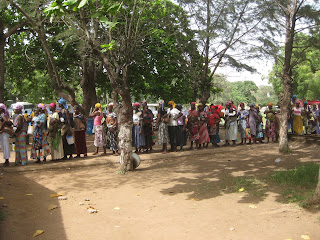
one of the lines for our medical care station

Around 11, we had already run out of some of the creams, and it was clear that we would start running out of some of the syrups, multivitamins and paracetamol. With no signs of the lines lessening, we decided to make an emergency run back to the PSGH offices, where we had extra stocks of some of the drugs. The clothing station opened around 11:30, and then an hour or so later, it was announced that the food was ready to be served. With other places for people to go, our lines were finally becoming a little bit more manageable! Dennis arrived from church around then, and immediately jumped right in. All the volunteers even got free food around 2pm: a welcome respite!
people waiting patiently for clothes and food; security guard and huge pile of clothes at far right

By about 3pm, the last dregs of people were filtering in, and we were able to start packing up. It had been over 6 hours of mayhem, but with over 80 volunteers at our medical station alone (about 10 times the amount of volunteers as last year!), everyone agreed that it had been the most well organized ESK yet! PSGH will conduct another similar free health outreach day, in conjunction with its annual general meeting in August, so stay tuned. We learned a lot of good lessons this time around, so I expect things will be even better managed in the future. It was truly impressive to see the hundreds of volunteers giving up time on their precious weekend to help those less fortunate than themselves, and I was just happy to be a part of it!

See more pictures at the Joy FM website!

Monday, April 5, 2010

A Ghanaian Funeral

A quick note of apology for taking so long to post something new. Jeremy visited, then Lindsay visited, then work got busy. I know excuses are lame, and I was thinking of you guys the whole time....it'll never happen again.

I was informed last month that Charles’ mother, Dora Poku, passed away, and that he would be out of the office for much of the next few weeks planning the funeral with his family members in his home town: a small village in the Brong Ahafo region of central Ghana, about 7 hours drive Northwest of Accra. After a week, a date had been set, and a noticeable buzz of anticipation filled the office with each passing day. The anticipation was a foreign sensation for me, as a funeral in the America is not usually looked forward to. Also, it usually happens less than a week after the death, so there really isn’t a whole lot of time. But in Ghana, it is another ballgame. Funerals are scheduled weeks and often months ahead of time, so that all family members and friends have ample heads up to travel back for it.

poster outside our office notifying people of the upcoming funeral

About a week before the event, we had a little meeting to decide who would/could/wanted to go, how we would get there, and what an appropriate gift would be for the family (It is customary in Ghana to give money as a gift for the bereaved family.). I definitely wanted to go, both to support Charles and to experience a Ghanaian funeral, and so did Dennis, John, Jonas, and Vivian, our executive assistant. It was decided that we would be taking a big coach bus, and that everyone in the office would chip in some cash for the family, with another monetary gift also coming from PSGH itself. A typical Ghanaian funeral spans an entire weekend, so the five of us left on Friday night after work.

The main “bus station” in Accra is basically a huge parking lot across the street from the much smaller government-run bus transportation hub. It is filled with hundreds of buses and vans of various sizes crammed in, in what seems like no particular order. These informal buses supplement and now completely dwarf the insufficient fleet of public transportation options. When we turned into the main entrance to the “station” we were met by dozens of men yelling at us, asking where we were going and steering us in the right direction: their right direction not necessarily being our right direction. But, for the most part, they were extremely helpful, and like many things in Ghana, something that seems to be lawless chaos turns out to have its own very clear order, if not completely observable at first sight. Vehicles going to particular areas around Ghana all congregate in certain areas of the lot on a first come first serve basis. Nothing leaves at a pre-arranged time, but rather when it is full, allowing the next vehicle in line to begin taking on passengers. So, the tickets Jonas bought for us earlier in the day said 8:30pm, but really, it could be any time before or after that, depending on the demand.

We got there around 8 to find our big coach bus about 1/3 full, which meant that we would need about 50 more people before we could shove off and would most likely be leaving well after 8:30. In the meantime, the mobile hawkers selling food and others goods from baskets carried on their heads were in full force at our windows. By the time we ended up leaving around 9:15, I could have purchased a used book, a toothbrush, ice cream, a bandana and so much more. Around 9 we were treated to a full 10-minute sales pitch from a medicine salesman who actually boarded the bus. I was sitting next to John, our accountant, who provided the color commentary for me. He said “It’s quite sad, but watch how many people buy his products when he is done talking.” And John was right. When the salesman went around to collect the fruits of his labor, at least a dozen people bought something.

our trusty red coach bus

When we finally pushed off, I thought we were done with the hawkers hissing and banging on windows and could enjoy several hours of hassle-free peace. But it was not so. As soon as we started moving, a woman in the front row stood up and began addressing the rest of the bus. I didn’t really need John’s translation (but enjoyed it anyways) to know that she was preaching the gospel. John told me that this was very common. She would probably go on for at least half an hour, and then collect whatever money the passengers gave her before getting off and boarding another bus heading back to the station to do it all again. It wasn’t so much the unsolicited preaching that surprised me, but it was the passenger’s reaction to it that really hammered home the whole Christianity in Ghana thing for me. Whereas my reaction to having more religion shoved in my face was to get extremely annoyed and contemplate heckling, everyone around me seemed to really enjoy her presence. They would sing along to the hymns and songs she led, follow perfectly in the call-and-response portions and repeat obedient “Amens” when appropriate. Religion in the parts of America where I have lived really only pokes its head out around holidays (e.g. Easter and Christmas Catholics and High Holidays and Passover Jews) and takes a back seat at most other times in the year. But here in Ghana, religion is everything. It is intertwined with every single facet of life, and it is because of god that everything happens and it is with god that all things are possible. I can’t really stress that enough.

The bus ride was fairly uneventful, where they showed Mel Gibson’s extremely violent “Apocalypto” followed by a new Ghanaian movie called “Chelsea.” Most Ghanaian movies are fairly unwatchable, where the production quality provides ample opportunity to play a game out of searching for the background lights, microphones and wires that should not have made it into the shot, but did. 95% of them are about a love triangle, and in this regard, “Chelsea” was no different. However, the quality was much higher than usual, and the main character of Chelsea, center of the love triangle, was gorgeous, by all standards, which made it much more watchable. (I would later learn that she once dated Ghanaian soccer superstar Michael Essien…obviously.)

The bus dropped us off in Mim, the town next to Charles’ hometown of Bediako, at about 4am, just in time to hear the first Muslim call to prayer over the town’s PA. (Around 10-15% of Ghanaians are Muslim, with much higher concentrations the further north you go.) We caught a lucky tro-tro to go the last 10 minutes, where we were met by a smiling Charles and his brother. Despite the hour, loud African pop music could be heard over the town. As Charles and his brother showed us to the one-room house where we would be staying, we walked by hundreds of plastic chairs arranged in neat rows, as Dennis turned to me and excitedly exclaimed “This will be a great funeral.” The house’s one room sported a big bed and two full couches. We all entered the one room, got settled onto the couches, and then Charles and his brother stood up to face their guests. Charles spoke in Twi, so I was pretty lost, but Dennis provided translation. He explained that it is a formality that needs to be performed the hosts ask the guests why they have come. Dennis responded that we have come to mourn with our good friend and co-worker over the loss of his mother. We then presented the monetary gift from the 5 of us and were instructed to present the other gift, on behalf of PSGH, at the ceremony tomorrow afternoon. With the formalities out of the way, Dennis, Jonas and I stayed there to sleep, while Charles took John and Vivian to other quarters.

A few hours later we were awoken by Charles, telling us that the ceremony would begin around 8am. We took turns taking a bucket shower, my first, (Bediako lacks running water), and then I followed Dennis’ lead by wearing a black suit, feeling slightly vindicated for bringing one with me to Ghana. As we followed Charles’ through the streets of his boyhood town, Bediako by daylight seemed very cozy. Small wooden houses and mud-bricked huts lined the narrow red-dirt roads. We came upon the same lines of plastic chairs which we had walked by the night before, but this time they were all full, whose occupants faced the entrance to what was a walled courtyard. Inside the courtyard, many more rows of plastic chairs lined the walls, all facing inward towards a closed tent. As we entered the courtyard, it was customary to shake hands with everyone already seated. This would turn out to be at least a hundred people, most of who looked at me like I was not unlike an alien. I tried to return their gazes with a strong handshake, eye contact and a solemn nod of my head. There was a microphone wielding MC whose job it was to announce the current arrivals to everyone already seated. This helped somewhat, as they explained that we were Charles’ co-workers who had traveled from Accra. We then took our seats along the back wall of the courtyard (with a nice booklet on each chair), and the next half hour or so was spent receiving others (more handshakes). Most attendants wore black, with all family members wearing shirts and dresses of a color-coordinated orange-patterned fabric, and most spent this time crying. After a while, the family members folded up one side of the tent to reveal the body lying on bed with the casket behind. Everyone then formed a line to circle the body and pay their last respects. This lasted another half hour or so, and it was a little after 9 when we departed back to the house.

I learned that it would be another couple hours before the next part of the ceremony: the church service. At the house, we ate a late breakfast of eggs and bread and then slept a little bit more. At about 11:30, we were again woken up by Charles to go to the service. Charles led us to the intersection of the two main roads at the center of town. The hundreds of plastic chairs had been rearranged in four big groups under tents all facing the main tent in the intersection, under which was the casket, flanked by the family members and the reverend. What followed was the church service, which consisted of the normal choruses, scripture readings and sermon, but which also included a nice biography and then three tributes: from Dora’s generation of family, from her children and then from her church. All of these could be easily followed along in the booklets we received earlier. There was a lot less crying, and a lot more reflection on life and death in this part of the ceremony, and I was amazed at the turnout. There were easily over 300 people there; pretty much the entire town came to a halt so that everyone could pay their respects to their fallen village member. I was personally befriended by a group of children who would not leave my side for the entire service. John got a kick out of it, and kept stealthily snapping off photos, reminding me that there was a good chance that I was the first white person they had ever seen in person.

When the service was completed around 1, everyone got up and walked up a short hill with the casket to the graveyard for the burial. This was actually the shortest part of the whole thing, and only took about 20 minutes. After that, Charles said that it was time for lunch, and he led us to another house, where we were served fufu with light soup and grasscutter meat. Let me do some translating. Fufu is a spongy dough ball of sorts usually made from pounded cassava and always served in soup. Light soup is the standard fare, and just means a tomato-based slightly spicy broth. Grasscutter is the name of a type of bushmeat, a local delicacy from an animal that looks like sort of like a porcupine (but, according to Wikipedia, with the much less appetizing name of a "greater cane rat"). All in all, it was pretty tasty, and we ate in the nice, airy house, drinking fanta and watching another Ghanaian love triangle movie.

throng of people heading up the hill to the burial site

fufu in light soup with grasscutter meat...yum.

After about an hour, we went back to the sleeping house to rest a little bit more before the last bit, which was the formal presentation of gifts to the family. We vegged out and napped a little bit until about 4, when we got dressed (this time without our suit coats!) and followed the sound of the drumming to a street that had again, been lined with the plastic chairs and tents. (At this point, everywhere I walked, I was being followed by little children, yelling “obroni!”, and coming up to me to shake hands or high-five. At one point, a little boy just came up alongside me, put his hand in mine, and walked with me indefinitely. This went on for about 5 minutes, until his mother came and grabbed him apologetically.) On one side of the street, there was a troupe of about 5 or 6 drummers beating away non-stop. There were traditional drums held with your knees and played with hands, stand alone drums played with straight sticks and then a very cool drum in the center which was played with sticks bent at a 90 degree angle. Directly across from the drummers was the family tent, where they all sat, some still dressed in orange and others in regal, flowing red fabrics. They sat behind a wooden folding table atop of which was a glass display case into which all of the gifts were being deposited. Again, the MC was there to announce the arrivals, as well as the gifts, and again, we did a big round of hand-shaking, stopping to give Charles a big hug, before taking our seats.

drummers

I spent the next hour or so, shaking a lot of hands and watching the drummers, as they played for what seemed like twenty minutes at a time. It was very clear that we had now moved from sadness to reflection to celebration, and those crying eyes were replaced with bright, cheerful ones above wide, laughing smiles. Along with the drummers came a lot of dancing, and I successfully parried several attempts from people trying to pull me up to dance. Before we knew it, it was 6 o’clock, time for us to make it back to the neighboring town of Mim to catch the bus back to Accra. As the five of us crammed into a taxi, Charles and his brother approached carrying huge burlap bags filled with yams, cassava and plantains (about 20 pounds for each of us!). They were gifts from the family to show appreciation for us coming all the way to Bediako and for our generous gifts.

It turned out to be the exact same bus that we had taken coming there, so we were again treated to “Apocalypto” and “Chelsea”. We had to stop over in Ghana’s second biggest city, Kumasi, to pick up more passengers, and another sneaky woman came on to subject us to another hour of unsolicited preaching. This time it didn’t seem as bad as before, perhaps because I was very glad to have had the opportunity to experience a Ghanaian funeral. I was able to tune out the preacher and reflect on the past day. So much of international development has to do with quantifiable variables like income, school attendance, and disease prevalence. And while it is of the utmost importance to measure and quantify these things, there are many other variables like the importance of community, ceremony and family that are much more difficult to quantify, but that Ghana and many other developing countries have in spades. All I know is that if that many people show up to my funeral, I’ve done something right.

Wednesday, February 17, 2010

Theory and Reality: A Natural Experiment

Yes, another blog about malaria…deal with it. ***DISCLAIMER***This entry became longer than intended, so please know that going in. There is, however, a story involved, so hopefully it won’t seem as long as it is.

In my previous Malaria 101 posting, I spoke of how Ghana’s new “Strategic Plan for Malaria Control” calls for moving from a presumptive clinical diagnosis to a diagnosis based on laboratory testing or rapid diagnostic test (RDT). In theory, this has tremendous potential to reduce costs for patients and the overall health system; to decrease the likelihood of drug resistance emerging, thereby preserving the efficacy of artemisinin-base combination therapies (ACTs); and to improve the health outcomes for the public by treating patients for the disease that is actually ailing them. That is in theory; in practice (aka: in reality) is another story entirely. To illustrate this, I will detail a natural experiment I was lucky enough to conduct some weeks ago. But first, a little bit more explanation of the malaria diagnostic situation.

When ACTs first came on the scene 5-10 years ago, the malaria community was so happy that there was a highly efficacious, well-tolerated alternative to chloroquine and SP (the two antimalarials in wide use at the time, to which plasmodium falciparum had developed high resistance profiles in several countries), that it’s number one priority became increasing access to ACTs as quickly as possible. In this regard, many countries (including Ghana) made ACTs available over the counter, instead of needing a prescription, and the WHO recommended clinical diagnosis in high burden areas, especially for children under 5. So basically, for the last 5-10 years, if you felt feverish or sick in Ghana, you could pop into your local pharmacy or licensed chemical seller shop*, they could take a look at you, declare that in their opinion it seemed likely that you had malaria, give you a regimen of ACT, transaction completed and you were out the door: not much different than buying advil. But ACTs are not advil. Ibuprofen (advil) fights inflammation. ACTs are anti-infectives that fight living microbes that put up a fight because they don’t want to die. The other issue is price, and the main catch with ACTs is that they are significantly more expensive than chloroquine and SP. Many people can only afford these alternatives, which are actively discouraged by the government but still widely available in the private sector. Alternatively, if a person demands ACT but cannot afford a full regimen, irresponsible drug dispensers have been known to provide less-than-complete doses.

Fast forward to 2010 where several developments have caused the global malaria community and Ghana’s Ministry of Health (MoH) to rethink their treatment strategy. First, there is a growing body of evidence that malaria is being significantly over-diagnosed and, consequently, ACTs over-prescribed. In Ghana, those numbers look something like this: around 90% of patients presenting with fever at both public and private sector health facilities were diagnosed with malaria, whereas the percentage of those febrile patients that actually had malaria (confirmed through laboratory tests) was more around 50%. This is alarming not only because of the vast, unnecessary use of ACTs and other antimalarials, but also because so many sick people are not being treated for the illnesses they have. Second, the first documented cases of resistance to ACTs have been documented along the Thai-Cambodian border. This is troubling both because that is the same hotspot where chloroquine resistance first appeared in the 1950s (before spreading to the rest of the world) and because there is no new antimalarial drug in the pipeline to replace ACTs if they significantly lose efficacy. Third, there is promising evidence of reduced malaria transmission rates in some countries (including Ghana). While this is a very exciting development, it also means that the over-diagnosis that stems from equating all fevers with malaria is even more pronounced. The fourth and final development is the emergence of RDTs on the scene. RDTs for malaria are pretty awesome; they are very easy to administer (a little finger prick, a drop of buffer and voila), they are quick (results in 15 minutes), they are relatively affordable (less than $1) and they are very accurate** (sensitivity and specificity in the high 90th percentiles).

So, faced with these 4 developments, some pioneering countries have decided to change their treatment guidelines. But, as is so often the case, the difference between theory on paper and realities in practice may be massive. The MoH has not rolled this new program out yet, but a little natural experiment I was able to conduct highlights some of the practical issues it might be facing in the private sector. And the story goes like this:

I should first say that one of my number one priorities upon landing in Accra was to secure some RDTs for myself. It took me about a week, but I was eventually able to procure some from the MoH. I had to buy an entire box (30 tests), but like a good boy scout, I was prepared. I kept them under my bed at home.

One day at work, John, PSGH’s good-natured accountant and Jonas, its hard-working on-site handyman, declared that they weren’t feeling very well, and both thought (or in their own words, knew) that they had malaria. Jonas was feverish and achy all over. John, while not feverish, was also achy and had a badly sore throat with bitterness in the back of his mouth: a symptom, he said, that was unique to his bouts of malaria. Rosslyn, PSGH’s head of public health (and a pharmacist like Dennis), immediately took a slip of paper and began writing down some ACTs she recommended, so that Jonas could run out and buy them. Sensing the opportunity, I jumped in and asked if we couldn’t first use RDTs to make sure that they actually had malaria. For a split second you could hear a pin drop, but then they all decided to humor me. I offered to go home with Charles (PSGH's driver) immediately and grab them, but it was already late in the day and John and Jonas both decided that they were fine waiting until first thing in the morning. I felt bad, like I was the reason for them not being treated today, like I was the white man rationing the medication for the Africans. John, always quick with a sarcastic barb, grinned and said, “We will take the test, but I fear we are wasting them, since I have no doubt that it is malaria.” Jonas nodded his agreement. Again, I offered to go home to grab the tests, so we could do them now, but John, seeing the anxiety on my face and sensing the tension, put his arm around my shoulder and said “No worries. Tomorrow, we will see.”
John, PSGH's sly, slick-dressed accountant

Jonas, PSGH's always-smiling handman, with his typical headphones

Tomorrow came quickly, and I was sure to bring the box of RDTs to the office. Jonas was already hard at work when Dennis and I arrived, but we decided to wait for John to do the test. Waiting anxiously for John’s arrival, I opened the box to look through its contents. It was filled with lots of little, individual packages neatly arranged in a space-saving manner. The box contained: single-use sterilized lancets (miniature plastic swords), single-use alcohol swabs, single-use pipettes, the bottle of buffer and the test cards. While it was a little confusing staring at all those little packages, when John arrived, Rosslyn took over - she had actually attended a MoH training session to learn how to correctly administer it – and it was pretty logical. You wipe the tip of the index finger with the alcohol swap, do a little finger prick with the lancet, get a few drops of blood with the pipette, drop two or three into one of the little basins on the card, squeeze two drops of the buffer into the other, and wait 15 minutes for results.
box of malaria RDTs and contents, from left: test card and pipette, buffer, alcohol swap, and sterilized lancet

We administered the tests in Rosslyn’s office, which I currently share with her. Jonas excitedly granted his finger to Rosslyn and watched the proceedings. John, on the other hand, had a decidedly all-knowing air about him, as if this was a meaningless perfunctory task which would only confirm what he had known all along. The “patients” left the room for the interim, as I snuck furtive glances at their test cards on Rosslyn’s desk. RDT results are displayed with 2 clearly-defined lines that would either appear or not on the face of the card. If the “control” line appeared, it meant that you had conducted the test correctly; if it did not, you had to do it over. If the other line appeared, a case of malaria was confirmed. Pretty simple: two lines = yes, one line = no. After a few minutes, the control lines on both of the tests appeared (good), and Rosslyn and I waited anxiously (I saw her sneaking glances, too) for the others. 15 minutes passed, 20 minutes passed, for good measure, we waited a full 30 minutes, but no second line appeared on either test.

RDT card showing negative result, on left are the two basins where the buffer and blood are dropped

When Rosslyn left her office to break the (good) news to them, their immediate response was to question the quality and validity of the test: “Are you sure this thing works?!?” “I’m sure I have it!” Rosslyn successfully parried those concerns by assuring them that the RDT is very accurate and a false negative is extremely rare. The next question, which Rosslyn so eloquently posed to me upon re-entering her office, was more troubling: “OK, now what?” In theory, the answer to the “OK, now what?” question is that the person should now go to the hospital for more tests to determine the identity of the bug that is actually ailing him/her. But I don’t have to reiterate what is wrong with theory. In reality, John had already started taking SP the day before, and Jonas did not want to wait in line at the hospital for more tests, so he did nothing and ended up feeling better in a few days. From a public health standpoint, this little 2-person experiment can provide a lot of insight into challenges facing this new diagnostic policy, especially in the private sector:

1) The public’s perception of what is and is not malaria is incorrect. This might be the consequence of too much of a good thing, where donors, government ministries, NGOs and others have put so much stress on combating malaria that the general public perceives the problem to be worse than it is. Every Ghanaian has grown up knowing and fearing malaria since birth, so when in doubt, they err on the side of malaria. It’s a common sense approach that anyone would do, but it is a real problem that is both very tough to fix and getting bigger, as malaria transmission rates go down.

2) Getting patients and practitioners to use and trust the validity of the RDTs will be a big hurdle. This was evidenced by John and Jonas’ initial reaction to their test results. In the public sector, this is not so much of an issue, but when patients have to actually pay for the RDT with their hard-earned money (instead of just finding a shop that will give them antimalarials without taking an RDT), this is a major challenge. There is also a growing body of evidence showing pharmacists and others dispensing anti-malarials anyways, even in the presence of a negative RDT result. It is not just patients who need to work on their trust issues.

3) Issue 2 in compounded by the profit motive of practitioners. As we know all too well in America, when healthcare is provided by parties with a profit motive, the incentives affecting behavior do not always align with those actions necessary for optimal individual or public health outcomes. Pharmacists in Ghana make good money dispensing anti-malarial drugs. This new policy calls for testing all possible malaria patients with an RDT, and that a good chunk of them (who they would have dispensed anti-malarial drugs to in the past) will come back negative. A negative result will mean that you can either give them something OTC (most likely with a lot smaller profit margin than an ACT) or tell them to go to a hospital for more tests (no further monies coming into your shop). How likely is it that pharmacists and other, less-trained dispensers will turn sick patients away because they need to have more tests done? How likely is it that the patient will actually go wait at the hospital for those tests, when the reason they came into the pharmacy in the first place might have been to avoid those same lines?

4) What did John and Jonas do? John chose to incorrectly self-medicate, while Jonas chose to do nothing. Leaving alone the fact that John managed to procure an antimalarial (SP) which is not supposed to be available anymore outside public hospital (and only used for pregnant women), how likely is it that patients with a negative RDT result will self-medicate, or go from shop to shop until they find one that will give an anti-malarial without conducting an RDT first? The policy is only as strong as its weakest link. And Jonas did nothing. Whether because he did not want to miss work, did not want to wait at the public hospital, could not afford a private clinic, or any other one of myriad reasons, is this outcome any better than anti-malarial over-prescription?

5) This entry is becoming much too long, so the final lesson that can be learned from my little experiment is that laboratory capacity will become even more important when this policy is rolled-out. Two RDTs = two negative results = two more patients that should then go get further testing done. The number of trained laboratory technicians capable of conducting the requisite amount of tests is already much too low in all developing countries. Microscopy takes time, culturing samples takes time, and these health workers are already spread too thinly. Some tests take days or weeks for results: days or weeks in which the patient is still sick. If we really expect patients to obediently wait it out, the MoH should couple this policy roll-out with adequate increased investments in laboratory capacity. Is that happening? All signs on the ground point to no.

So what is my part in all this? I’m trying to secure funding for PSGH to go all over the country and run training programs for all of its member pharmacists in this new policy prior to roll-out. I think that’s enough malaria talk for today. We’re really getting into the weeds on some of this stuff, and I know you’re all very excited! My next couple extries won't be malaria-related at all, so I'll give you all a break for a bit, I promise!


* In Ghana, licensed chemical sellers are able to dispense only over the counter products (including anti-malarials). They are not trained pharmacists and, so, cannot dispense prescription drugs, but they outnumber pharmacists almost 10 to 1.

** There are dozens of malaria RDTs currently marketed worldwide, all with variable quality. Thankfully, the WHO and others partners have begun conducting lot tests to determine the quality of each. The brand I procured from the MoH received very high marks for quality from the WHO lot tests.